Life shows that Ukrainians and Russians are not one people, as Vladimir Putin claimed shortly before the full-scale invasion of Ukraine by Russian troops.
The recent arrest in St. Petersburg of singer Diana Loginova for performing anti-war songs, and the lack of reaction from Russian society to this essentially barbaric action by the security forces, is clear confirmation of this.
For the Ukrainian mentality, such actions by the authorities are completely unacceptable. In Ukraine, this would have provoked an immediate and adequate response from civil society, which did not happen in Russia. It is worth remembering that Yanukovych lost his post as President of Ukraine precisely because of the beating of students participating in a peaceful protest on Maidan Nezalezhnosti by security forces. Millions of citizens immediately took to the streets in Kyiv, which marked the beginning of the end of Yanukovych’s rule.
Unlike Russia, Ukraine has long-standing democratic traditions dating back to the times of Kyivan Rus, the Grand Duchy of Lithuania, and the Zaporizhzhia Sich.
At the same time, the Russian mentality was formed in conditions of authoritarianism and the serfs’ total dependence on their masters. This is what shaped the servile mentality of Russians and their willingness to carry out any whims and instructions of their masters. This explains their willingness to endure all the humiliation and abuse of the people by Putin and a small group of his cronies, to go to war and die for those who have been mocking people for many years, as well as systematically destroying and plundering Russia, guided solely by personal interests and ambitions. This behavior of Russians is a vivid confirmation that the vast majority of them have a slave mentality, which explains the lack of reaction from society to the barbaric behavior of Russian siloviki and, from the point of view of a civilized person, the repression against singer Diana Loginova and other young people who publicly express anti-war sentiments.
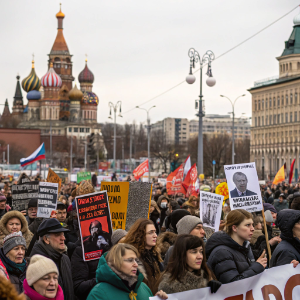
We have already discussed the psychological characteristics of the majority of Russians, so now let’s talk about the minority. It is known that after the arrest of Diana Loginova, spontaneous protests broke out in some cities. So far, they have not gained the momentum necessary to overthrow Putin’s totalitarian regime, but this may change over time. The lack of success in the war with Ukraine will inevitably cause dissatisfaction among various social groups within the RF which will severely damage the reputation of Putin and his inner circle. This will undoubtedly lead to a weakening of the regime and a loss of control over the vast territory that modern Russia occupies. In turn, the international sanctions imposed by the West will also have a significant impact on the state of the economy and the socio-political situation in Russia, which also will be not in Putin and his regime’s favour. As a result, local elites will begin to look for a way out of the crisis and distance themselves from the central government and its decisions.
The most significant changes are expected in the North Caucasus and the Far East. The inhabitants of those regions of Russia are the poorest and have suffered the most as a result of Putin’s adventure in Ukraine.
Under these circumstances, we should expected that a critical mass of dissatisfied people and leaders who will lead them on the path to freedom and independence will soon appear in the RF.
The anti-war protest songs sung by young people in St. Petersburg are just the first signs of change. Next, with Putin’s regime weakened by the disastrous war in Ukraine, opposition forces could take advantage of the situation. With clearly defined political goals and objectives, they have a real chance of coming to power and changing Russia. Most likely, the struggle for power there will begin between the democrats, the vast majority of whom are in exile in the West, and the radicals from the RDK, the Siberian Battalion, and the “Freedom of Russia” Legion, who are currently fighting Putin’s totalitarian regime with weapons in their hands as part of the Armed Forces of Ukraine.
Given the historical experience and socio-political processes that are already beginning to emerge in Russian society, it can be argued that after its defeat in Ukraine, the RF will cease to exist in its current form and disappear from the political map of the world. The most likely scenario is that after the collapse, new independent states will emerge on the territory of modern Russia. It is difficult to say exactly which ones, but the most likely are the central regions of the RF, Tatarstan, Bashkortostan, Siberia, the Far East, and the North Caucasus. Obviously, all this will mean global geopolitical shifts and will have consequences, so all responsible world leaders and politicians must take this into consideration and prepare themselves properly to overcoming future challenges and threats that may arise in connection with the collapse and disintegration of the world’s largest and most aggressive totalitarian empire.
Oleh Bereziuk,
Institute for Global Politics
(Image generated by neural network)